Main menu
You are here
Real Estate, Basic Income, and Virtual Estate
 The following is heavily derived from two interviews on the podcast "Economics Explored" hosted by Gene Tully; namely "Rethinking Property and Taxation" and "The Pirate Party's Economic Platform". In those podcasts and in this article, the ideas of 19th-century economist Henry George are explored and elaborated, including his advocacy for a taxation on land values and an early version of Universal Basic Income. This is supplemented with a more contemporary concern with digital rights, which Henry George also explored through his concerns on patents and copyright. All of these ideas have contributed significantly in my roles in the Pirate Party Australia, the Secular Party, and the Fusion Party, which was established as a merger of the Science Party, Pirate Party, Secular Party, Vote Planet, and Climate Change Justice Party. In 2025, I stood as the candidate for the Fusion in the Federal seat of Bennelong.
Henry George, and the economics of Georgism, is a classical economic approach. Rather than just looking at money and growth rates, he also looked at economic classes, at political economy, like one finds with Adam Smith, David Ricardo, John Stuart Mill, and Karl Marx. His best-selling book from 1879, "Progress and Poverty", was concerned that with such technological progress, there was still so much poverty. George, following a position shared by other classical economists, placed much of the blame on the landlord class, broadly defined as those who derive income from rents without adding to production. This is different to the common term of "landlord" which means a person who rents out a house and land. For George and others, it meant the land value only. Henry George had a big influence in Australia and visited gaining many adherents to his message which still has relevance today with the many problems relating to our natural resources, whether we talk about capital gains tax discounts, negative gearing, mining royalties, and so forth; however you cut it, Georgists emphasise land value taxation (LVT). Another thing the Georgists make a very contribution to in Australia is pointing our our over-investment in land and the resulting property bubbles. George's influence can still be found in state-based land taxes, local councils that assess rates on unimproved site value, and even the building of Canberra.
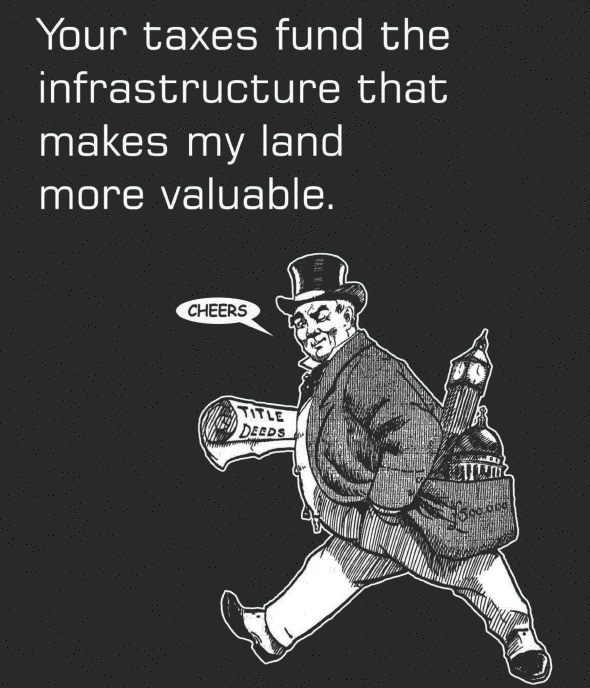
Now it must be said, if you're involved in progressive circles and thinking about what's right or wrong about the economy, it's very easy to stumble across Georgists, and they have a movement, and they can be very passionate, even evangelical, to the point that they're like the drunk guy with a guitar at a party that won't leave you alone. But it's also possible to support land value taxation, to support many of the things Henry George had to say, and not be like that. A lot of economists, even most, are in that position without being too evangelical. Now, they can do some good work; the Melbourne group, Prosper Australia, would check the value of vacant blocks, and do an analysis of water usage in blocks of units to calculate real vacancy rates, so when people say "we just need to release more land to developers" they can respond, "What about existing land and vacancies?" It was actions like that and discussing matters with some serious intellectuals among the Georgists that made me think it about it very hard and carefully, adopting what I call "Minimalist Georgism"; we want to have good economic activity, we don't want speculators sitting on land and forcing prices up. We also want fair compensation and pricing for infrastructure. If we have a property and the council builds a garbage dump close to us, we're probably going to try to get compensation for that. But if the government builds infrastructure that's going to increase our land values, there’s a moral problem with that.
Many taxes are distortionary and have a deadweight loss, and it should be mentioned that the Georgists, who are normally opposed to neoclassical economics, are prepared to take up the neoclassical concept of deadweight losses. Anyway, many taxes are distortionary from the ideal market price because the additional cost of tax will change supply and demand; they have a deadweight loss, not just from the cost of administering the tax, but also the economic and welfare losses from a reduction in trade; people are poorer in material goods and monetary benefits because prices are higher. But taxes on the unimproved value of land are different to taxes on the improved value, like housing. However, these things are entangled. Because the more valuable the land is, the more floors you can build and the more profitably you can build. So in a sense, you are making a profit from putting improvements on the land, but you can make more profit from improvements if the value of the land is larger to start with. I think Henry George was operating; it wasn't plausible that someone would go in and build a 20-story, you know, apartment block; people would build something with two or three stories, if you were lucky. The world was different back then.
This said, there are some economists, such as Stiglitz, who argue that various rents make up the ideal level of taxation and government expenditure under the subtle title "Henry George theorem", and it is conditional, of course. But it does suggest a good source of social welfare, or what I call "a pirate UBI". Technically, it's a guaranteed minimum income; your universal basic income is a wad of cash that you get regardless. In Alaska, they have this thing, the Alaska Permanent Fund where they've re-allocated the money from their oil and mineral reserves there. And everyone just gets a plonk of money every year, but in a sense, that is sharing the real wealth that's created. A pirate UBI, or the guaranteed minimum income we are talking about, if you make the neutral amount of money, you pay no tax, nor do you get a top-up. If you make less than that, you get a bit of a top-up, so the government gives you a bit of money. And finally, if you’re making no money, then you get a wad of cash, which is our guaranteed minimum income. And notice, in a sense, it's means-tested. We’re not just giving people lots of money regardless, so we are trying to avoid the inflationary risk. And, in fact, really do our best to make sure the budget balances, and we're not printing money to pull this thing off.
Now, in our policy platform, if you look at it, we do say, look, land value taxation is a good thing; it would be good to sort of re-emphasise our tax system to do that. When you have a universal basic income, there are lots of people who will throw moral rocks at it, but one of the things we are trying to do is actually cost it so that we don't need to print money to give people this basic income. One of the principles is that once you give people that basic income without constraints, we reasonably expect many people will just work a few hours a week because they don't fall off a cliff and lose all their benefits. Getting back to Henry George, one way of capturing this improvement in land value, I have yet to see a queue of guilt-ridden people at the tax office saying, "Wow, you’ve increased the value of my land enormously. I’ve got to give you some of that money back".
Now, looking at virtual estate, there is the whole thing of patent trolls who have a bunch of patents sitting on the shelf, and all they do is run around with a mallet and whack people on the head who try to make something that vaguely looks like their patent; that’s a complete abuse of what a patent should be. But it is another example of a monopoly, like land. Now there's this stuff about "pirates". Way back when computer gamerss were in copying software, and the industry was calling them "pirates", and they embraced that and ran with it, because they could appreciate how the software industry was actually flexing its muscles and abusing its position, and how it was effectively limiting technology by producing what economists call "damaged goods", and its from artificially limiting the potential distribution of a software product or any other information that the industry gains an "unearned increment", like landlords do with land rents. It's more than just computer games, of course; it includes all patented research, like medical research. Obviously, we want people to be compensated for discoveries and inventions, especially in the field of medicine, but artificial patents and monopolies are not the right way to do it.
If you actually look at our policies, those of the Pirate Party, you'll find that we're very much into individual freedom, at the same time as we're also into social concern. Now every party claims to get that balance or claims to sort of put some effort into it. But the Pirate Party does a better job of realising that duality than I think any other political party. We certainly cherish individual freedom, freedom of speech, and freedom from government interventions in private lives. We're basically concerned about government and corporations in equal measure. It's a left-libertarian point of view, if you like.
- Log in to post comments